
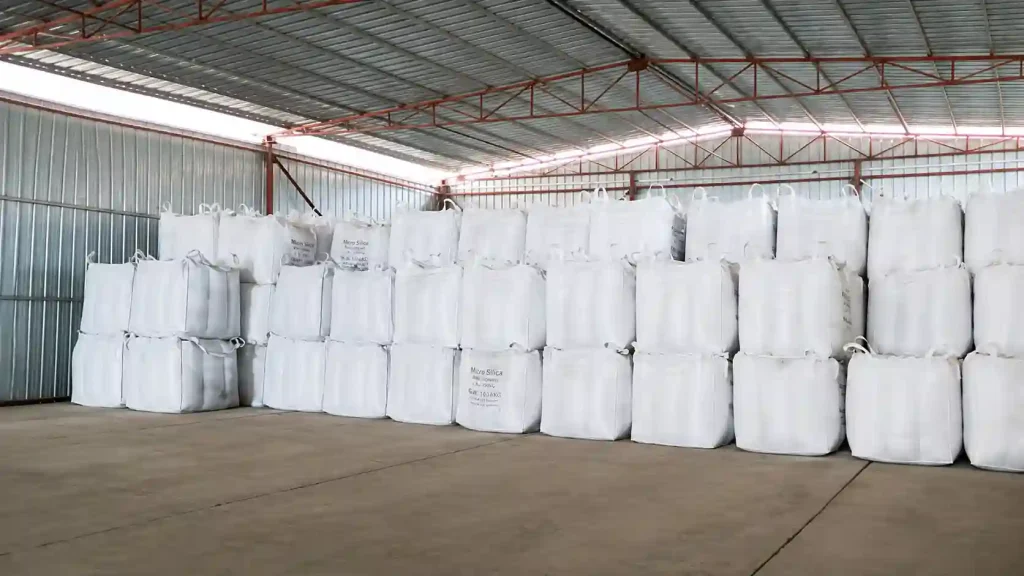
Micro silica is one of the most effective mineral additives for improving the strength, durability, and overall performance of concrete. Also known as silica fume, micro silica is an extremely fine powder that contains a high percentage of silicon dioxide (SiO₂).
When manufacturers add micro silica to a concrete mixture, it reacts with products from cement hydration. As a result, it helps fill tiny spaces between cement particles and creates denser and stronger concrete.
Today, contractors widely use micro silica for concrete in high-strength concrete, bridges, marine structures, tunnels, industrial floors, dams, foundations, and other demanding construction projects. In addition, micro silica reduces water penetration and improves the mechanical strength of concrete. Therefore, it offers an excellent solution for structures exposed to water, chemicals, chlorides, abrasion, and harsh environmental conditions.
Furthermore, micro silica can extend the service life of concrete structures and reduce maintenance requirements. For this reason, engineers often choose it for projects that require high strength and long-term durability.
This article explains what micro silica is, how it works in concrete, its main benefits and applications, and the important factors to consider when adding it to concrete mixtures.
What Is This product?
This product is an extremely fine pozzolanic material consisting mainly of amorphous silicon dioxide. It is typically collected as a by-product during the production of silicon metal and ferrosilicon alloys in electric arc furnaces.
The particles of micro silica are considerably smaller than ordinary Portland cement particles. Because of this extremely fine particle size, micro silica can fill microscopic spaces between cement particles and aggregates.
The combination of its physical filling effect and chemical pozzolanic reaction makes micro silica for concrete an effective material for producing dense and high-performance concrete.
This product is commonly supplied in different forms, including:
Undensified micro silica
Densified micro silica
Slurried micro silica
Densified this product is widely used for transportation and commercial concrete production because its higher bulk density makes handling, storage, and dosing more practical.
How Does This Product Work in Concrete?
The performance of this product in concrete is based on two important mechanisms: the filler effect and the pozzolanic reaction.
During cement hydration, Portland cement reacts with water and produces calcium silicate hydrate (C-S-H), which provides much of the strength of hardened concrete. The hydration process also produces calcium hydroxide.
Micro silica reacts with calcium hydroxide to form additional calcium silicate hydrate. This additional C-S-H contributes to a stronger and denser cementitious matrix.
At the same time, the extremely fine micro silica particles fill microscopic voids between cement particles. This improves particle packing and reduces the interconnected pore structure of the hardened concrete.
As a result, concrete containing micro silica can achieve:
Higher compressive strength
Lower permeability
Improved durability
Better resistance to chloride penetration
Greater abrasion resistance
Improved chemical resistance
These properties explain why micro silica has become an important component of many high-performance concrete formulations.
Benefits of This Product for Concrete
1. Increased Concrete Strength
One of the primary reasons for using this product is to produce higher-strength concrete.
The pozzolanic reaction creates additional C-S-H gel and improves the internal structure of hardened concrete. When the concrete mixture is properly designed and cured, this can significantly improve compressive strength.
For this reason, micro silica is frequently incorporated into concrete used for high-rise buildings, heavily loaded structural elements, bridges, foundations, and other engineering projects requiring high mechanical performance.
2. Reduced Concrete Permeability
Another major advantage of micro silica for concrete is its ability to reduce permeability.
Conventional concrete contains microscopic pores and capillary channels through which water, chlorides, and other aggressive substances can penetrate.
The fine particles of micro silica help fill these spaces and create a much denser concrete structure. Reduced permeability is especially important for structures continuously or periodically exposed to moisture.
Applications include:
Water reservoirs
Dams
Foundations
Basements
Tunnels
Swimming pools
Marine structures
Wastewater facilities
Lower permeability can significantly improve the service life of reinforced concrete structures.
This Product for High-Strength Concrete
Micro silica is extensively used in high-strength and high-performance concrete.
High-strength concrete is required for structures where conventional concrete may not provide sufficient mechanical performance. The addition of micro silica allows engineers to develop concrete with a denser microstructure and higher compressive strength.
Typical applications include high-rise buildings, columns, precast concrete components, bridge elements, and heavily loaded foundations.
However, micro silica should be incorporated as part of a properly engineered mix design. Factors such as water-to-binder ratio, cement content, aggregate grading, chemical admixtures, mixing procedures, placement, and curing all affect final concrete performance.
This Product for Waterproof Concrete
Water penetration is one of the major causes of deterioration in concrete structures. Moisture can carry chlorides, sulfates, and other aggressive substances into the concrete.
Using this product can substantially reduce the permeability of concrete by refining its pore structure.
For this reason, micro silica concrete is commonly specified for projects where resistance to water penetration is particularly important.
Examples include underground structures, water tanks, reservoirs, basements, retaining structures, tunnels, and foundations.
It is important to understand that micro silica improves the water resistance and low-permeability characteristics of concrete, but it does not necessarily replace dedicated waterproofing systems when a project specification requires membranes or other waterproofing materials.
This Product for Marine Concrete
Marine environments are among the most aggressive conditions for reinforced concrete.
Seawater contains chlorides that can penetrate concrete and eventually reach reinforcing steel. Once corrosion begins, expansion of the reinforcement can lead to cracking, spalling, and structural deterioration.
This product for concrete helps create a dense, low-permeability matrix that limits chloride penetration.
It is therefore widely considered for:
Ports
Harbors
Jetties
Piers
Coastal bridges
Sea walls
Offshore structures
Improved resistance to chloride ingress can contribute significantly to longer service life in marine infrastructure.
This Product for Bridges and Infrastructure
Bridges, highways, and transportation structures experience demanding environmental and mechanical conditions.
Concrete in these structures can be exposed to moisture, chlorides, temperature changes, abrasion, heavy traffic, and chemical attack.
The addition of this product can improve concrete durability and help protect reinforced concrete from premature deterioration.
Bridge decks, piers, columns, precast elements, and repair systems are common infrastructure applications where silica-fume concrete may be specified.
This Product in Industrial Flooring
Industrial floors require high resistance to abrasion, impact, and heavy loads. Warehouses, factories, workshops, logistics centers, and industrial facilities frequently experience continuous traffic from forklifts and other equipment.
Concrete containing this product can provide increased strength and abrasion resistance when properly formulated.
Its dense surface and improved mechanical properties make micro silica concrete suitable for demanding industrial environments where conventional concrete may experience excessive wear.
This Product in Shotcrete
Micro silica is also widely used in shotcrete applications.
Shotcrete is concrete or mortar pneumatically projected onto a surface at high velocity. It is commonly used in:
Tunnels
Underground construction
Mining
Slope stabilization
Rock support
Structural repair
This product can improve cohesion and reduce rebound in suitable shotcrete formulations. It can also contribute to improved strength and durability of hardened shotcrete.
These characteristics make micro silica particularly valuable for underground and infrastructure projects.
Micro Silica for Dams and Hydraulic Structures
Hydraulic structures remain continuously exposed to water. Therefore, they require durable concrete with low permeability.
Contractors can use micro silica for concrete in dams, channels, spillways, reservoirs, and other hydraulic structures.
In addition, micro silica reduces water penetration by creating denser concrete. It also increases strength and improves abrasion resistance. As a result, it performs well in areas exposed to flowing water and demanding conditions.
Micro Silica Dosage in Concrete
The appropriate dosage of this product depends on the required concrete properties, cement type, aggregates, admixtures, environmental exposure, and project specifications.
This product is generally proportioned as a percentage of the cementitious material. In many concrete applications, silica fume may be used at approximately 5% to 10% of the cementitious material by mass, although the optimum dosage must be established through mix design and performance testing.
Higher or lower percentages may be specified for specialized applications.
Because this product has an extremely high specific surface area, it can increase water demand. Therefore, high-range water-reducing admixtures or superplasticizers are commonly used to maintain the required workability without increasing the water-to-binder ratio.
Importance of Proper Mixing
Correct mixing is essential when using micro silica for concrete.
The material must be distributed uniformly throughout the mixture to achieve consistent performance. Poor dispersion can affect workability and may prevent the concrete from achieving its intended properties.
Concrete producers should carefully control:
Material dosage
Water content
Mixing time
Admixture dosage
Concrete temperature
Placement
Compaction
Curing
Trial mixes should normally be performed before large-scale production, especially for high-performance structural concrete.
This product and Concrete Durability
Durability is one of the strongest reasons to specify this product.
A concrete structure may have adequate initial strength but still experience premature deterioration if aggressive substances can easily penetrate its internal structure.
By reducing permeability, micro silica can improve resistance to several deterioration mechanisms, particularly those associated with chloride ingress and water penetration.
This makes this product especially useful in environments where structures are expected to achieve long service lives with reduced maintenance requirements.
Micro Silica vs. Ordinary Concrete
Ordinary concrete can provide adequate performance for many general construction applications. However, projects exposed to aggressive conditions often require more advanced concrete technology.
Compared with conventional concrete, properly designed micro silica concrete can offer:
| Property | Ordinary Concrete | Micro Silica Concrete |
|---|---|---|
| Compressive strength | Standard | Higher potential strength |
| Permeability | Moderate | Significantly reduced |
| Chloride resistance | Standard | Improved |
| Abrasion resistance | Standard | Improved |
| Concrete density | Normal | Denser matrix |
| Durability | General purpose | Suitable for demanding exposure |
The exact improvement depends on the mix design, dosage, materials, workmanship, and curing conditions.
Applications of This Product for Concrete
Because of its combination of strength and durability benefits, this product is suitable for numerous construction applications.
Major applications include:
High-strength concrete
High-performance concrete
Marine and coastal structures
Bridge decks and bridge piers
Dams and hydraulic structures
Water reservoirs and tanks
Tunnels and underground structures
Industrial floors
Precast concrete
Shotcrete
Concrete repair materials
Foundations and basements
Sewage and wastewater structures
High-rise buildings
Its versatility makes micro silica an important material for both infrastructure and specialized concrete projects.
Advantages of Using This Product
The main advantages of this product for concrete include:
Increased compressive strength
Reduced water permeability
Improved resistance to chloride penetration
Denser concrete microstructure
Improved abrasion resistance
Better performance in aggressive environments
Enhanced durability of reinforced concrete
Suitability for high-performance concrete
Improved performance of certain shotcrete mixtures
Potential for longer structural service life
These benefits make micro silica particularly valuable where durability is as important as initial concrete strength.
Conclusion
Micro silica for concrete provides an effective solution for improving concrete strength, reducing permeability, and increasing long-term durability. Its extremely fine particle size fills microscopic voids in the cement matrix, while its pozzolanic reaction contributes additional strength-producing compounds.
These characteristics make micro silica particularly suitable for high-strength concrete, marine structures, bridges, tunnels, dams, reservoirs, industrial floors, foundations, shotcrete, and other demanding construction applications.
When correctly proportioned, mixed, placed, and cured, micro silica can help produce dense and durable concrete capable of performing under aggressive environmental and structural conditions. For construction projects where high strength, low permeability, and extended service life are important requirements, micro silica remains one of the most valuable supplementary cementitious materials available.
Its extremely fine particles fill microscopic voids within the cement matrix. Its pozzolanic reaction also consumes calcium hydroxide and forms additional calcium silicate hydrate (C-S-H), contributing to a denser and strong
Micro silica can improve concrete's compressive strength, durability, density, abrasion resistance, and resistance to water and chemical penetration when properly proportioned and cured.
The dosage depends on the required concrete performance and mix design. A common range is approximately 5–10% of the cementitious material by mass, although specific applications may require different proportions.