
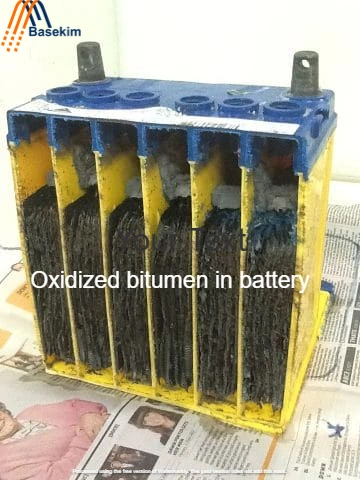
Oxidized bitumen in battery
Bitumen Battery Grade: A Technical Solution to Cell Leakage
In battery manufacturing, sealing technology determines both the life and reliability of the product. As alkaline cells power everything from household gadgets to industrial tools, sealing failure is not an option. Here, bitumen battery grade plays a critical role in minimizing electrolyte leakage, especially between the gasket and the metal housing of the cell.
Despite rapid advancements in battery chemistry, one challenge persists: maintaining a leak-proof seal throughout the cell’s lifespan. Standard sealants, like oxidized bitumen, fatty polyamides, or epoxy-based materials, often fall short under thermal and mechanical stress. Fortunately, Basekim, a trusted supplier from UAE and Turkey, provides advanced bitumen battery grade solutions that address the limitations of conventional materials.
Why Bitumen Battery Grade Matters in Modern Alkaline Cells
In alkaline batteries, sealing failures usually result from a poor bond between the sealant and the battery’s metal casing. Most seals rely on asphaltic compounds like bitumen, but their effectiveness varies significantly depending on the surface they contact.
When used on nickel-plated steel cans, bitumen forms a relatively stable seal. However, the same seal on unplated steel often fails. The issue lies in the different surface bonding characteristics. The bitumen battery grade used must adapt to both plating types while maintaining integrity under mechanical pressure and chemical exposure.
Thus, the choice of sealant is not just about adhesion—it’s about thermal behavior, chemical resistance, and mechanical durability. And this is where Basekim’s bitumen battery grade excels.
Oxidized Bitumen in Battery Seals: Performance and Pitfalls
Many manufacturers have tried to improve sealing performance using Blown bitumen in batteries, either on its own or blended with fatty polyamide resins. The theory is solid: oxidized bitumen offers better thermal resistance and bonding than raw bitumen. However, in practice, the outcome often disappoints.
At room temperature and above, both oxidized bitumen and fatty polyamides become soft and tacky. During assembly, these materials are prone to smearing, contamination, and damage. Additionally, they don’t always conform well to surface irregularities in the cell’s metal body. As a result, small gaps remain—just enough to allow electrolyte to escape over time.
Even high-performance epoxy-polyamine resins, although more stable, present challenges. Their softness and sensitivity to shear forces make them less suitable for high-speed or automated battery assembly processes.
Basekim’s Bitumen Battery Grade: Engineered for Reliability
This is where Basekim, a specialized manufacturer in Turkey and the UAE, introduces a clear advantage. Its bitumen battery grade is designed specifically to overcome the flaws of both Oxidised asphalt and traditional resins.
Here’s what sets Basekim’s product apart:
Optimized viscosity for clean, accurate application
Superior bonding to both plated and unplated metal surfaces
High thermal stability, maintaining structure up to 100°C
Chemical resistance to alkaline electrolyte solutions
Non-tacky finish post-curing for clean assembly
These features ensure the sealant maintains its structure during both storage and operation. Most importantly, Basekim’s product reduces the risk of electrolyte leakage that plagues many battery designs.
Battery Sealing Bitumen: A Role Beyond Adhesion
The role of battery sealing bitumen extends beyond physical bonding. It also acts as a chemical barrier. Electrolyte components are aggressive, and over time they corrode the metallic interior if exposed. Bitumen provides a shield that prevents this interaction.
Additionally, bitumen helps to buffer the mechanical forces between the gasket and steel shell. Batteries face expansion and contraction during use. A rigid sealant might crack, but bitumen’s semi-elastic behavior prevents this.
Basekim’s bitumen battery grade is formulated for this exact application. By enhancing flow control and bond strength, it ensures uniform coverage in the critical seal area—every time.
Manufactured to Global Standards in UAE and Turkey
Basekim operates modern production facilities in both UAE and Turkey, allowing it to serve global markets with minimal lead time. Both sites follow ISO-certified quality systems and produce according to international battery-grade standards.
Clients receive consistent quality with every batch. This matters when your product lifecycle depends on sealing performance. Whether for AA cells, specialty industrial batteries, or cylindrical lithium-ion casings, the bitumen battery grade from Basekim meets or exceeds technical specifications.
Custom Formulation and Technical Support
Because different battery manufacturers use different materials, gaskets, and casings, one formula does not fit all. That’s why Basekim offers custom-formulated bitumen sealants.
Whether your product faces high heat, long shelf life, or vibration exposure, Basekim engineers can help adapt the sealant properties to your process. This includes:
Modifying softening point
Adjusting penetration depth
Customizing curing behavior
Support includes both formulation advice and on-site trials. This ensures the seal works under real-world conditions—not just in the lab.
Sustainable Production Without Compromise
Even as Basekim optimizes for technical performance, it also takes sustainability seriously. The company uses environmentally sound processes in its UAE and Turkey factories. This includes solvent-free production lines, energy-efficient refining, and reduced waste discharge.
Sustainable production doesn’t just help the planet—it ensures long-term supply chain stability. That means you get a consistent product without disruption or compliance issues.
The Outlook: Bitumen Battery Grade as a Strategic Material
As global demand for portable and backup power grows, battery production will only accelerate. And sealing materials will become even more important. Bitumen battery grade sealants like those from Basekim ensure manufacturers can keep pace without compromising quality or safety.
While alternative materials like oxidized bitumen, polyamides, and even epoxy blends still play a role, their limitations are hard to ignore. If you need reliable, scalable, and application-specific sealing solutions, bitumen battery grade from Basekim offers a proven alternative.
Therefore
Battery sealing is a technical challenge, not just a manufacturing step. It directly affects product performance, safety, and shelf life. Using bitumen battery grade, especially one engineered by a trusted supplier like Basekim, gives battery manufacturers a vital edge.
With facilities in UAE and Turkey, Basekim provides high-quality, technically optimized sealing materials tailored for the battery industry. It’s a smarter choice—for performance, safety, and sustainability.