
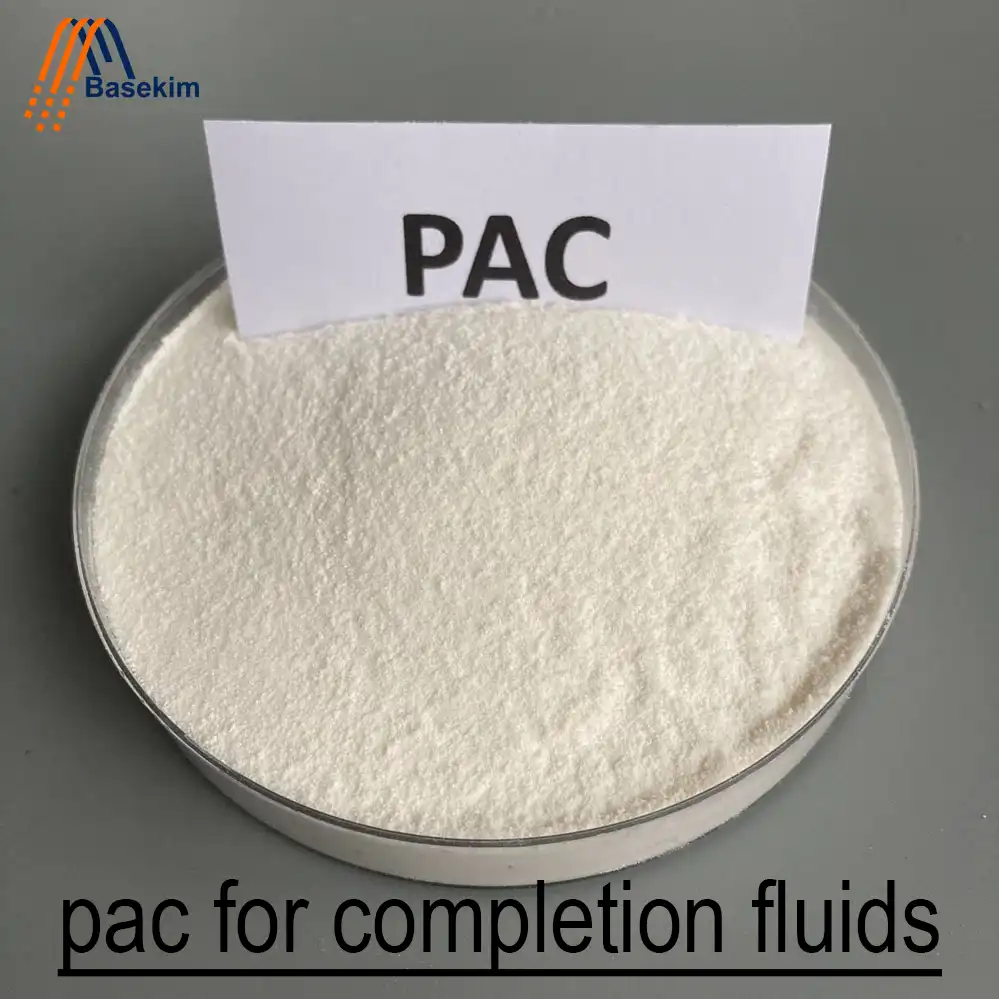
In the oil and gas industry, completion fluids play a critical role during the final stage of well development. To make these fluids more efficient, stable, and safer for use, many engineers and buyers rely on PAC (Polyanionic Cellulose). This versatile polymer is highly valued for its excellent performance, especially in harsh conditions.
So, what makes PAC for completion fluids so important? Why do manufacturers prefer it over other additives? And how can BaseKim help your operations run smoother with quality bulk supply? Let’s explore all of this in simple, yet technical terms.
What is PAC (Polyanionic Cellulose)?
First of all, manufacturers derive PAC from cellulose, a natural substance found in plant fibers, and chemically treat it to enhance its stability across a wide range of temperatures and salt concentrations. That’s why it works perfectly in both freshwater and saltwater drilling or completion environments.
PAC is available in different grades, including low-viscosity (LV) and high-viscosity (HV). Each grade serves a different purpose, and engineers may use either type in completion fluids depending on the application.
Why Use PAC in Completion Fluids?
Although there are other polymers on the market, PAC stands out due to its performance, reliability, and environmental profile. Now, let’s look at the specific benefits of using PAC in completion fluids:
1. Excellent Fluid Loss Control
Completion fluids must maintain wellbore stability without damaging the reservoir. PAC helps reduce fluid loss to the surrounding formation. As a result, it protects the reservoir permeability and boosts well productivity.
2. Stable in Harsh Conditions
Completion fluids often face high temperatures, pressures, and salt concentrations. PAC remains stable in all of these conditions. Therefore, it continues to work even when other polymers break down.
3. Environmentally Friendly
Because it is derived from natural cellulose and modified with mild chemicals, PAC is considered safer for the environment. Moreover, it meets many environmental regulations for use in offshore and onshore wells.
4. Improves Rheology
PAC affects the viscosity and flow characteristics of completion fluids. This makes it easier to control fluid circulation, clean the wellbore, and suspend solids when necessary.
5. Compatible with Other Additives
Unlike some specialty polymers, PAC works well alongside other additives like salts, weighting agents, and biocides. That’s why it’s so widely used in completion fluid systems.
Key Applications of PAC in Oilfield Completion
Next, let’s explore how PAC is actually use in real oilfield operations. While drilling and cementing have their own needs, completion fluids are all about preserving well integrity and preparing for production.
Filter Cake Improvement
PAC helps form a thin, tough filter cake on the wellbore walls. This minimizes fluid invasion into the formation, which means you keep the reservoir clean and productive.
Reservoir Protection
Because PAC reduces solids content and controls filtration, it prevents fine particles from plugging the reservoir. This is especially important for sensitive formations like sandstone.
Sand Control
Engineers add PAC to brine-based fluids in some completion operations to support sand-control screens and gravel packs.
Friction Reduction
PAC helps reduce friction in the flow of fluids. As a result, pumping systems use less energy, and operations become more efficient.
PAC Grades and Selection
Choosing the right PAC grade is essential. Fortunately, BaseKim supplies both low-viscosity and high-viscosity PAC depending on your needs:
-
PAC-LV: Ideal for fluid loss control with minimal impact on viscosity
-
PAC-HV: Used when both fluid loss control and thickening are needed
If you’re not sure which one fits your application, our team at BaseKim can help you choose the best option based on your field conditions.
BaseKim: Your Trusted PAC Supplier
Not all PAC products are created equal. Some contain impurities, while others may not dissolve properly or perform consistently. That’s why you need a supplier who offers high-quality PAC for completion fluids, backed by technical expertise and reliable delivery.
Here’s why BaseKim is the supplier you can count on:
Wide Export Network
BaseKim supplies oilfield-grade PAC to clients across the Middle East, Asia, Africa, and Europe. Whether your operations are offshore or on land, we deliver to your site—on time.
Guaranteed Purity
Our PAC products meet international standards for oilfield use. They are tested for purity, solubility, moisture content, and performance before shipment.
Custom Packaging & Bulk Delivery
We offer PAC in 25 kg bags, jumbo bags, or bulk containers, depending on your need. Additionally, we ensure all packaging is moisture-proof for safe transport and storage.
Technical Assistance
Our technical team helps clients select the right PAC grade, dosing levels, and application method. So, even if you’re new to PAC, we’ve got you covered.
How to Store and Use PAC Effectively
For best results, PAC should be stored in cool, dry areas away from moisture. Keep the product sealed and protected from humidity. Once opened, use it promptly or reseal it tightly.
To mix PAC into your completion fluid:
-
Start with clean water or brine
-
Add PAC slowly while agitating
-
Allow time for full dissolution
-
Adjust pH and other additives as needed
With the right method, you’ll get a smooth, lump-free solution ready for field use.
Safety and Handling Tips
Even though PAC is relatively safe, always follow basic safety practices:
-
Wear gloves and goggles
-
Avoid inhaling dust
-
Use proper storage containers
-
Follow disposal guidelines if required by local laws
Because PAC is biodegradable and non-toxic, it is usually allowed in environmentally sensitive zones. Still, it’s good practice to double-check with local regulators.
Conclusion
To wrap up, PAC for completion fluids is one of the most essential and versatile additives in oilfield operations. It controls fluid loss, protects the reservoir, and ensures completion fluids remain stable and effective under pressure. Whether you operate in salt-heavy brine systems or high-temperature wells, PAC delivers consistent performance.
However, the effectiveness of PAC depends not just on its chemical structure, but also on its quality and how it’s applied. That’s why manufacturers and buyers choose BaseKim. We don’t just supply a chemical—we supply confidence, quality, and service.
If you’re ready to improve your oilfield completions with reliable PAC, reach out to BaseKim today. We’re here to help you complete every job—efficiently, safely, and profitably.